
Welcome to the Ammonoid subsite on Invertebrate Paleontology!
Please enter a genera name to retrieve more information.

Westonoceras
Classification
Phylum:
Mollusca
Class:
Cephalopoda
Subclass:
Nautiloidea
Order:
Discosorida
Family:
Westonoceratidae
Formal Genus Name and Reference:
Westonoceras FOERSTE, 1924
Type Species:
Cyrtoceras manitobense WHITEAVES, 1890, OD
Images
(Click to enlarge in a new window)
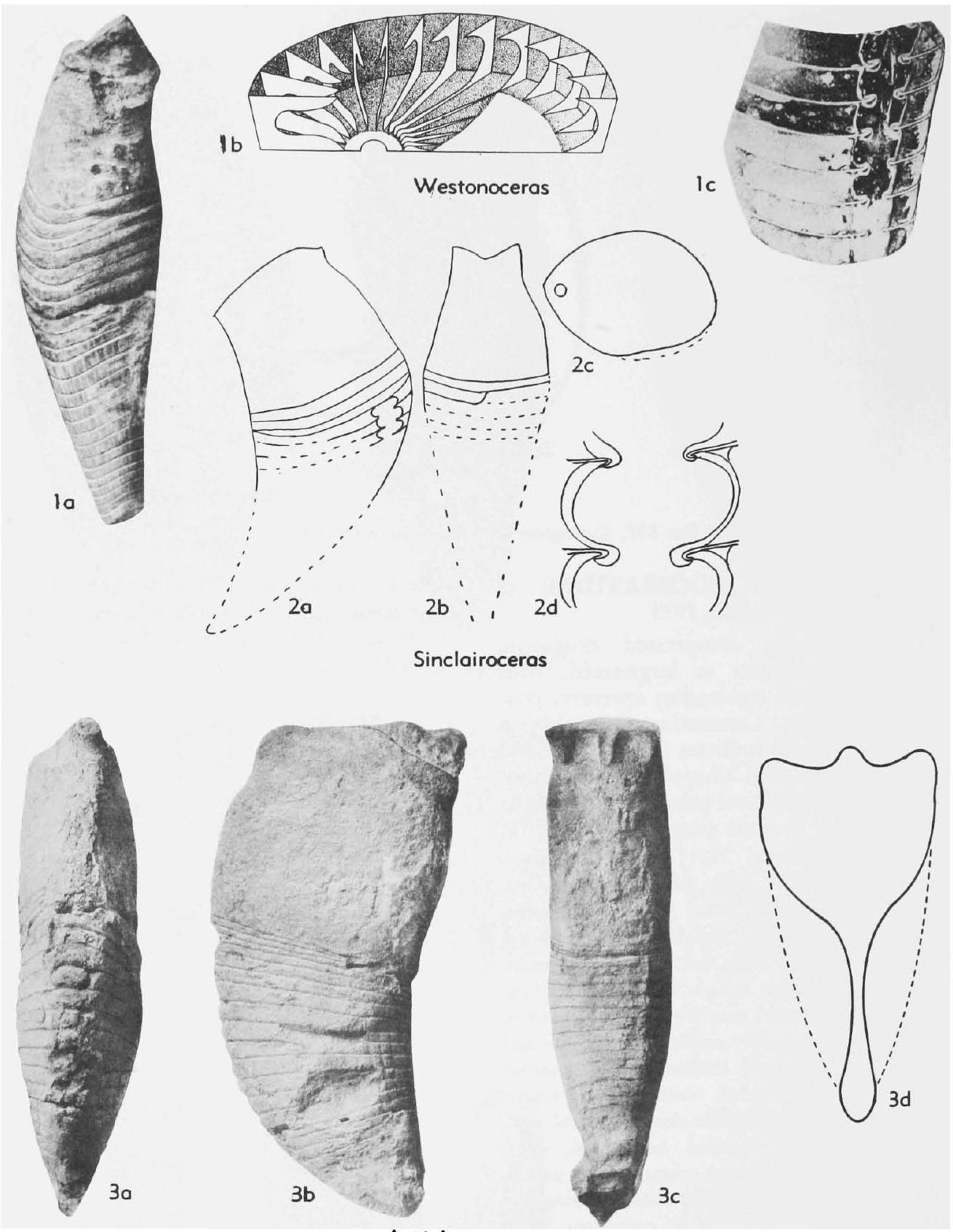 Fig. 239, 1a. *W. manitobense (Whiteaves), M. (or ?U.)Ord., Can. (Man.), dorsolat. view, x0.5 (59). -- Fig. 239, 1b. W. sp., diagrammatic representation of shape and distribution of cameral deposits, enlarged (185). -- Fig. 239, 1c. W. sp., Ord., Baffin Is., dorsoventral sec. of phragmocone showing cameral deposits and remnants of central tube in anterior part of siphuncle, x1.5 (long. sec. of siphuncle of same specimen, Fig. 229,A) (50).
Synonyms
Westenoceras, Thuleoceras
Geographic Distribution
N.Am.-Greenl.-N.Eu.
Age Range
Beginning Stage in Treatise Usage:
M.Ord.
Beginning International Stage:
Dapingian
Fraction Up In Beginning Stage:
0
Beginning Date:
471.26
Ending Stage in Treatise Usage:
U.Ord.
Ending International Stage:
Hirnantian
Fraction Up In Ending Stage:
100
Ending Date:
443.07
Description
Compressed, humped exogastric cyrtocones, early part of conch slender, gently exogastric to straight, rapidly expanding, convexity of ventral profile increasing, greatest gibbosity along anterior part of phragmocone and posterior part of body chamber, in cross section dorsum broadly rounded, venter narrow, sutures with lateral lobes, siphuncle close to ventral wall, segments strongly expanded, box-shaped, septal necks strongly recumbent, rings thick, parietal deposits initiated at septal foramina, growing forward and commonly forming continuous lining within siphuncle, cameral deposits invariably present.
References
Museum or Author Information
Classification
Phylum:
Mollusca
Class:
Cephalopoda
Subclass:
Nautiloidea
Order:
Discosorida
Family:
Westonoceratidae
Formal Genus Name and Reference:
Westonoceras FOERSTE, 1924
Type Species:
Cyrtoceras manitobense WHITEAVES, 1890, OD
Images
(Click to enlarge in a new window)
Fig. 239, 1a. *W. manitobense (Whiteaves), M. (or ?U.)Ord., Can. (Man.), dorsolat. view, x0.5 (59). -- Fig. 239, 1b. W. sp., diagrammatic representation of shape and distribution of cameral deposits, enlarged (185). -- Fig. 239, 1c. W. sp., Ord., Baffin Is., dorsoventral sec. of phragmocone showing cameral deposits and remnants of central tube in anterior part of siphuncle, x1.5 (long. sec. of siphuncle of same specimen, Fig. 229,A) (50).
Synonyms
Westenoceras, Thuleoceras
Geographic Distribution
N.Am.-Greenl.-N.Eu.
Age Range
Beginning Stage in Treatise Usage:
M.Ord.
Beginning International Stage:
Dapingian
Fraction Up In Beginning Stage:
0
Beginning Date:
471.26
Ending Stage in Treatise Usage:
U.Ord.
Ending International Stage:
Hirnantian
Fraction Up In Ending Stage:
100
Ending Date:
443.07
Description
Compressed, humped exogastric cyrtocones, early part of conch slender, gently exogastric to straight, rapidly expanding, convexity of ventral profile increasing, greatest gibbosity along anterior part of phragmocone and posterior part of body chamber, in cross section dorsum broadly rounded, venter narrow, sutures with lateral lobes, siphuncle close to ventral wall, segments strongly expanded, box-shaped, septal necks strongly recumbent, rings thick, parietal deposits initiated at septal foramina, growing forward and commonly forming continuous lining within siphuncle, cameral deposits invariably present.