
Welcome to the Ammonoid subsite on Invertebrate Paleontology!
Please enter a genera name to retrieve more information.
Trizonoceras
Classification
Phylum:
Mollusca
Class:
Cephalopoda
Subclass:
Ammonoidea
Order:
Goniatitida
Suborder:
Goniatitina
Superfamily:
Dimorphoceratoidea
Family:
Dimorphoceratidae
Subfamily:
Dimorphoceratinae
Formal Genus Name and Reference:
Trizonoceras GIRTY, 1909, p. 70
Type Species:
T. typicale, OD
Images
(Click to enlarge in a new window)
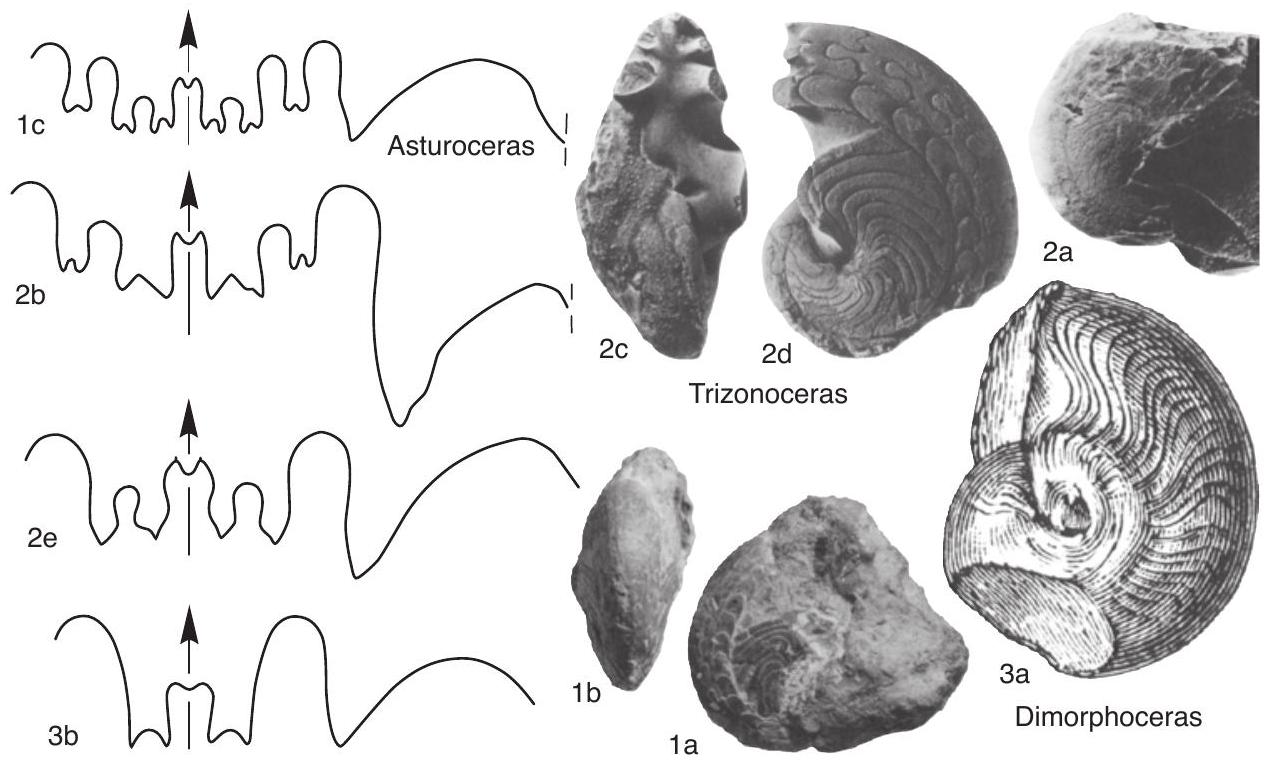 Fig. 24, 2a-b. *T. typicale, holotype, Caney Shales, Antler, Oklahoma, middle Chesterian, USNM 119598, a, side view, X 6, b, suture, diameter at 8.4 mm, X 9 (Manger & Pareyn, 1979).-Fig. 24, 2c-d. T. horreitense Manger & Pareyn, holotype, Ain el Mizab Formation, Djebel Horreit, Algeria, UA 77-217-1, X 3 (Manger & Pareyn, 1979). ——Fig. 24, 2e. T. kathleenae (Moore), suture, northeastern slope of Dough Mountain, 3.2 km south-southwest of Kiltyclogher, County Leitrim, Ireland, upper Visean, GSM Z1.5643, corrected by Ruzhentsev & Bogoslovskaia (1969a, fig. 1b), X 3.3 (Moore, 1958).
Synonyms
Geographic Distribution
Ireland, Algeria, Russia (Novaia Zemlia), Kazakhstan (South Urals), Tajikistan, China (Guangxi, Ningxia), USA (Arkansas, Oklahoma)
Age Range
Beginning Stage in Treatise Usage:
Mississippian (upper Visean)
Beginning International Stage:
Visean
Fraction Up In Beginning Stage:
66
Beginning Date:
335.91
Ending Stage in Treatise Usage:
Mississippian (Serpukhovian)
Ending International Stage:
Serpukhovian
Fraction Up In Ending Stage:
100
Ending Date:
323.4
Description
Similar to Dimorphoceras, but ventral lobe developing four branches regularly, ventrad ones always bifid, dorsad elements may be bifid
References
Museum or Author Information
Classification
Phylum:
Mollusca
Class:
Cephalopoda
Subclass:
Ammonoidea
Order:
Goniatitida
Suborder:
Goniatitina
Superfamily:
Dimorphoceratoidea
Family:
Dimorphoceratidae
Subfamily:
Dimorphoceratinae
Formal Genus Name and Reference:
Trizonoceras GIRTY, 1909, p. 70
Type Species:
T. typicale, OD
Images
(Click to enlarge in a new window)
Fig. 24, 2a-b. *T. typicale, holotype, Caney Shales, Antler, Oklahoma, middle Chesterian, USNM 119598, a, side view, X 6, b, suture, diameter at 8.4 mm, X 9 (Manger & Pareyn, 1979).-Fig. 24, 2c-d. T. horreitense Manger & Pareyn, holotype, Ain el Mizab Formation, Djebel Horreit, Algeria, UA 77-217-1, X 3 (Manger & Pareyn, 1979). ——Fig. 24, 2e. T. kathleenae (Moore), suture, northeastern slope of Dough Mountain, 3.2 km south-southwest of Kiltyclogher, County Leitrim, Ireland, upper Visean, GSM Z1.5643, corrected by Ruzhentsev & Bogoslovskaia (1969a, fig. 1b), X 3.3 (Moore, 1958).
Synonyms
Geographic Distribution
Ireland, Algeria, Russia (Novaia Zemlia), Kazakhstan (South Urals), Tajikistan, China (Guangxi, Ningxia), USA (Arkansas, Oklahoma)
Age Range
Beginning Stage in Treatise Usage:
Mississippian (upper Visean)
Beginning International Stage:
Visean
Fraction Up In Beginning Stage:
66
Beginning Date:
335.91
Ending Stage in Treatise Usage:
Mississippian (Serpukhovian)
Ending International Stage:
Serpukhovian
Fraction Up In Ending Stage:
100
Ending Date:
323.4
Description
Similar to Dimorphoceras, but ventral lobe developing four branches regularly, ventrad ones always bifid, dorsad elements may be bifid