
Welcome to the Ammonoid subsite on Invertebrate Paleontology!
Please enter a genera name to retrieve more information.

Lamottoceras
Classification
Phylum:
Mollusca
Class:
Cephalopoda
Subclass:
Endoceratoidea
Order:
Endocerida
Family:
Endoceratidae
Subfamily:
Genera known from fragmentary conchs, including siphuncles, with apical end and body chamber usually known or poorly known
Formal Genus Name and Reference:
Lamottoceras FLOWER, 1955
Type Species:
L. ruedemanni, OD
Images
(Click to enlarge in a new window)
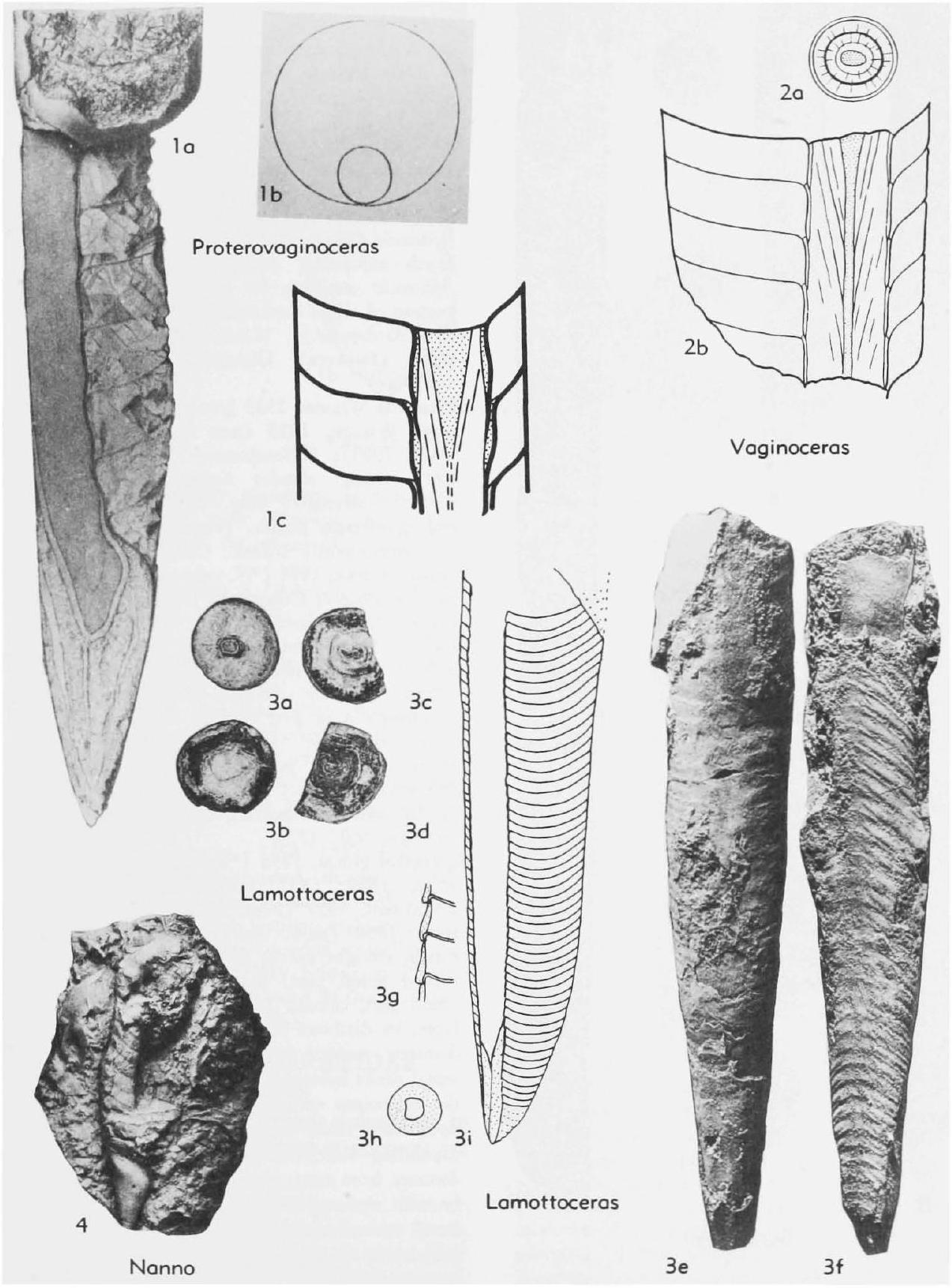 Fig. 114, 3a-f. *L. ruedemanni, USA (N.Y.), 3a-d, transv. secs. of siphuncles, x0.7; 3e,f, siphuncle, dorsal and ventral, x0.7 (44). -- Fig. 114, 3g-i. L. franklini FLOWER, USA (N.Y.); 3g, septal necks, connecting rings, X2; 3h,i, transv. sec. of siphuncle, long. sec. of conch, X0.45 (47)
Synonyms
Geographic Distribution
N.Am.
Age Range
Beginning Stage in Treatise Usage:
M.Ord. (Chazy.)
Beginning International Stage:
Darriwilian
Fraction Up In Beginning Stage:
56.9
Beginning Date:
463.02
Ending Stage in Treatise Usage:
M.Ord. (Chazy.)
Ending International Stage:
Darriwilian
Fraction Up In Ending Stage:
100
Ending Date:
458.18
Description
Large conchs, rapidly expanding in early part, later slender, with very short camerae, transverse, straight sutures. Siphuncle large, ventral, with inflated apical cone, septal necks very short, orthochoanitic, connecting rings very thick, endocones long, subquadrangular in cross section, extending forward as long lobes on mid-ventral and mid-dorsal inner surfaces of siphuncle.
References
Flower, R. H., 1955, Cameral deposits in orthoconic nautiloids: Geol. Mag., v. 92, p. 89-103, illus.
Museum or Author Information
Classification
Phylum:
Mollusca
Class:
Cephalopoda
Subclass:
Endoceratoidea
Order:
Endocerida
Family:
Endoceratidae
Subfamily:
Genera known from fragmentary conchs, including siphuncles, with apical end and body chamber usually known or poorly known
Formal Genus Name and Reference:
Lamottoceras FLOWER, 1955
Type Species:
L. ruedemanni, OD
Images
(Click to enlarge in a new window)
Fig. 114, 3a-f. *L. ruedemanni, USA (N.Y.), 3a-d, transv. secs. of siphuncles, x0.7; 3e,f, siphuncle, dorsal and ventral, x0.7 (44). -- Fig. 114, 3g-i. L. franklini FLOWER, USA (N.Y.); 3g, septal necks, connecting rings, X2; 3h,i, transv. sec. of siphuncle, long. sec. of conch, X0.45 (47)
Synonyms
Geographic Distribution
N.Am.
Age Range
Beginning Stage in Treatise Usage:
M.Ord. (Chazy.)
Beginning International Stage:
Darriwilian
Fraction Up In Beginning Stage:
56.9
Beginning Date:
463.02
Ending Stage in Treatise Usage:
M.Ord. (Chazy.)
Ending International Stage:
Darriwilian
Fraction Up In Ending Stage:
100
Ending Date:
458.18
Description
Large conchs, rapidly expanding in early part, later slender, with very short camerae, transverse, straight sutures. Siphuncle large, ventral, with inflated apical cone, septal necks very short, orthochoanitic, connecting rings very thick, endocones long, subquadrangular in cross section, extending forward as long lobes on mid-ventral and mid-dorsal inner surfaces of siphuncle.
References
Flower, R. H., 1955, Cameral deposits in orthoconic nautiloids: Geol. Mag., v. 92, p. 89-103, illus.