
Welcome to the Ammonoid subsite on Invertebrate Paleontology!
Please enter a genera name to retrieve more information.

Cyrtogomphoceras
Classification
Phylum:
Mollusca
Class:
Cephalopoda
Subclass:
Nautiloidea
Order:
Discosorida
Family:
Cyrtogomphoceratidae
Formal Genus Name and Reference:
Cyrtogomphoceras FOERSTE, 1924
Type Species:
Oncoceras magnum WHITEAVES, 1890, OD
Images
(Click to enlarge in a new window)
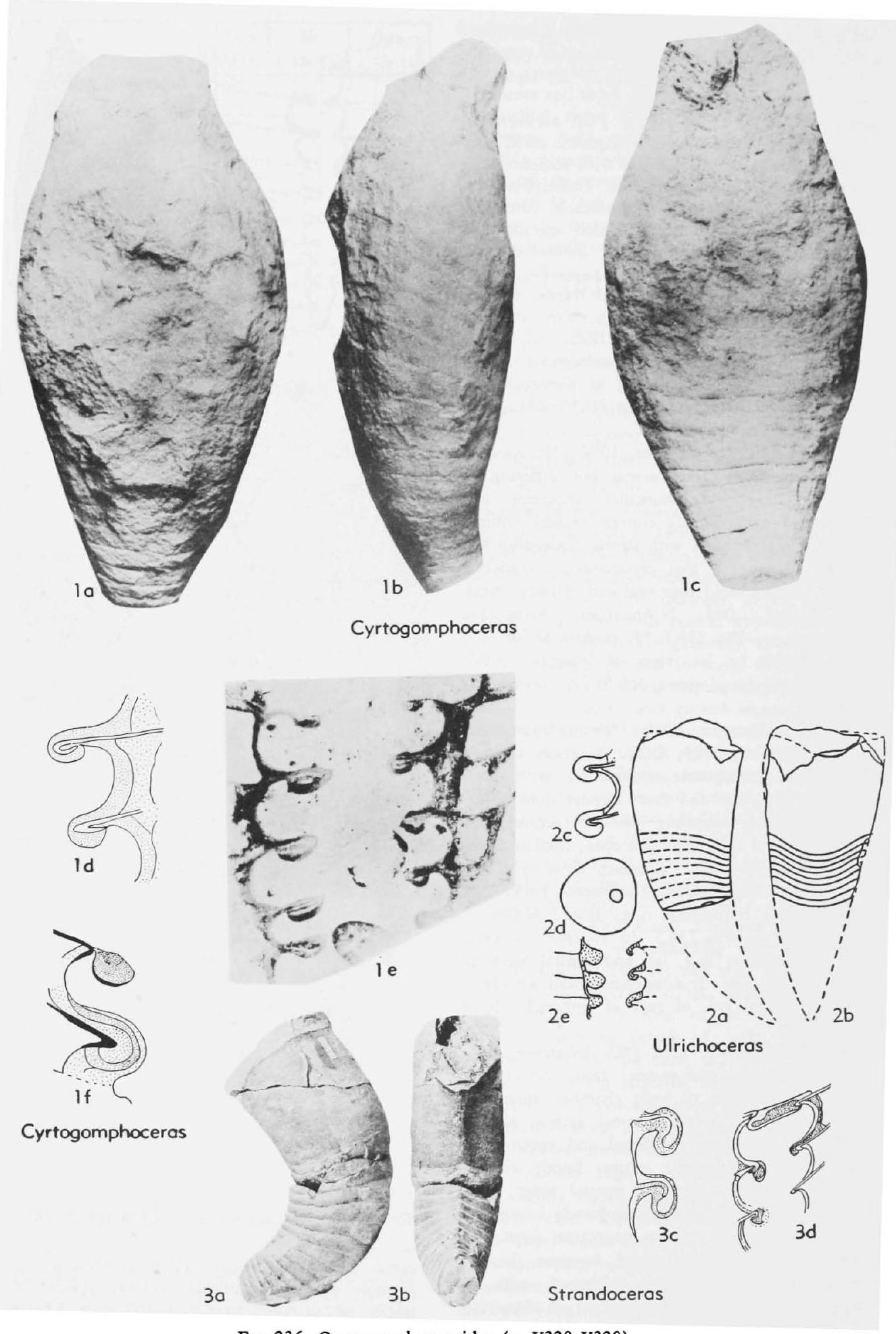 Fig. 236, 1a-c. C. nutatum Foerste & Savage, M. (or U.?) Ord., Can. (Hudson Bay), 1a-c, dorsal, lat., ventral views, x0.5 (50). .. Fig. 236, 1d. C. turgidum (Troedsson), Ord. (Cape Calhoun beds), N. Greenl., portion of connecting ring with large bullette, adapical (lower) one with 2 layers, x4 (50). -- Fig. 236, 1e,f. C. sp., Ord. (Mt. Silliman beds), Baffin Is., le, long. sec. of ventral side of siphuncle showing details of necks, thick connecting rings, and bullettes, x2, 1f, partial view of same, showing apparent secondary thickening on outside of connecting rings, enlarged (184).
Synonyms
Geographic Distribution
M.Ord.-U.Ord., N.Am.Greenl., Sil., Eu. (Est.)
Age Range
Beginning Stage in Treatise Usage:
M.Ord.
Beginning International Stage:
Dapingian
Fraction Up In Beginning Stage:
0
Beginning Date:
471.26
Ending Stage in Treatise Usage:
U.Ord., Sil.
Ending International Stage:
Hirnantian
Fraction Up In Ending Stage:
100
Ending Date:
443.07
Description
Large endogastric brevicones, fusiform in profile, expanding rapidly, gibbous over anterior end of phragmocone or base of body chamber, which contracts conically, aperture with ventral hyponomic sinus, cross section of conch generally strongly compressed, though circular in some forms, sutures with faint lateral lobes, sloping increasingly forward on dorsum in later growth stages, siphuncle large, slightly removed from venter, short segments broadly expanded, septal necks short, with strongly recurved brims, connecting rings thickened, bullettes swollen, but generally poorly seen, cameral deposits absent
References
Museum or Author Information
Classification
Phylum:
Mollusca
Class:
Cephalopoda
Subclass:
Nautiloidea
Order:
Discosorida
Family:
Cyrtogomphoceratidae
Formal Genus Name and Reference:
Cyrtogomphoceras FOERSTE, 1924
Type Species:
Oncoceras magnum WHITEAVES, 1890, OD
Images
(Click to enlarge in a new window)
Fig. 236, 1a-c. C. nutatum Foerste & Savage, M. (or U.?) Ord., Can. (Hudson Bay), 1a-c, dorsal, lat., ventral views, x0.5 (50). .. Fig. 236, 1d. C. turgidum (Troedsson), Ord. (Cape Calhoun beds), N. Greenl., portion of connecting ring with large bullette, adapical (lower) one with 2 layers, x4 (50). -- Fig. 236, 1e,f. C. sp., Ord. (Mt. Silliman beds), Baffin Is., le, long. sec. of ventral side of siphuncle showing details of necks, thick connecting rings, and bullettes, x2, 1f, partial view of same, showing apparent secondary thickening on outside of connecting rings, enlarged (184).
Synonyms
Geographic Distribution
M.Ord.-U.Ord., N.Am.Greenl., Sil., Eu. (Est.)
Age Range
Beginning Stage in Treatise Usage:
M.Ord.
Beginning International Stage:
Dapingian
Fraction Up In Beginning Stage:
0
Beginning Date:
471.26
Ending Stage in Treatise Usage:
U.Ord., Sil.
Ending International Stage:
Hirnantian
Fraction Up In Ending Stage:
100
Ending Date:
443.07
Description
Large endogastric brevicones, fusiform in profile, expanding rapidly, gibbous over anterior end of phragmocone or base of body chamber, which contracts conically, aperture with ventral hyponomic sinus, cross section of conch generally strongly compressed, though circular in some forms, sutures with faint lateral lobes, sloping increasingly forward on dorsum in later growth stages, siphuncle large, slightly removed from venter, short segments broadly expanded, septal necks short, with strongly recurved brims, connecting rings thickened, bullettes swollen, but generally poorly seen, cameral deposits absent