
Welcome to the Ammonoid subsite on Invertebrate Paleontology!
Please enter a genera name to retrieve more information.
Actinoceras
Classification
Phylum:
Mollusca
Class:
Cephalopoda
Subclass:
Actinoceratoidea
Order:
Actinocerida
Family:
Actinoceratidae
Formal Genus Name and Reference:
Actinoceras BRONN, 1835
Type Species:
A. bigsbyi, M
Images
(Click to enlarge in a new window)
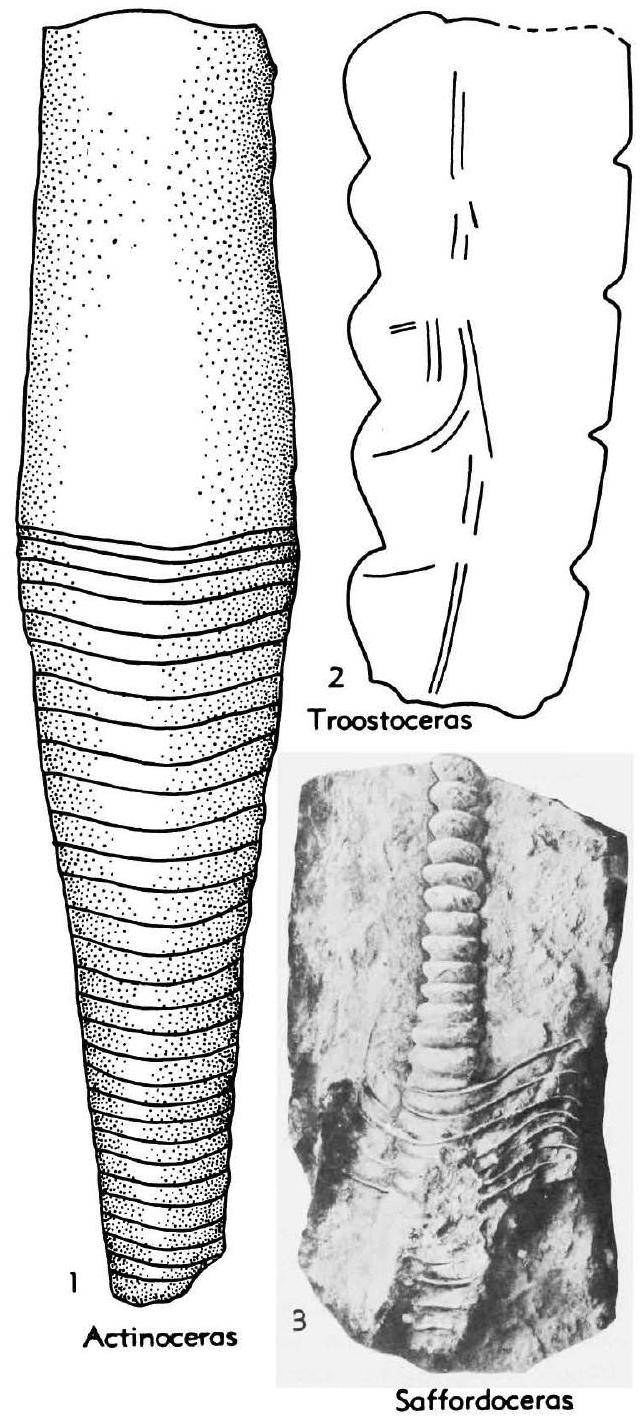 Fig. 141,1. A. ruedemanni FOERSTE & TEICHERT, M. Ord., USA (N.Y.) ; 1a,b, dorsoventral sec., transv. Sec., X0.7; 1c, lat. Long. Sec. through silphuncle, X1.6 (185); 1d, apical view of septum and siphuncle with radial canals, X0.75 (185). -- Fig. 142,1. A. beloitense (WHITFIELD), M.Ord., Can.(Ont.); ventral side, X0.3 (78).
Synonyms
Actinoceratites, Conotubularia, Arctinoceras, Metactinoceras
Geographic Distribution
N.Am.-Greenl.-N.Eu.-USSR (Sib.) -E. Asia.
Age Range
Beginning Stage in Treatise Usage:
M.Ord.
Beginning International Stage:
Dapingian
Fraction Up In Beginning Stage:
0
Beginning Date:
471.26
Ending Stage in Treatise Usage:
L.Sil.
Ending International Stage:
Homerian
Fraction Up In Ending Stage:
100
Ending Date:
426.74
Description
Large, straight, somewhat fusiform shells, with tendency to decrease in diameter from anterior part of phragmocone toward aperture; cross section subcircular to circular. Siphuncle large, generally somewhat off center, tending to decrease in diameter toward adult portion of phragmocone; septal necks long, brims relatively short; narrow endosiphuncular canal in mature stage with simple radial canals.. Cameral deposits common, generally of episeptal and hyposeptal type; circulus present in few species.
References
Museum or Author Information
Classification
Phylum:
Mollusca
Class:
Cephalopoda
Subclass:
Actinoceratoidea
Order:
Actinocerida
Family:
Actinoceratidae
Formal Genus Name and Reference:
Actinoceras BRONN, 1835
Type Species:
A. bigsbyi, M
Images
(Click to enlarge in a new window)
Fig. 141,1. A. ruedemanni FOERSTE & TEICHERT, M. Ord., USA (N.Y.) ; 1a,b, dorsoventral sec., transv. Sec., X0.7; 1c, lat. Long. Sec. through silphuncle, X1.6 (185); 1d, apical view of septum and siphuncle with radial canals, X0.75 (185). -- Fig. 142,1. A. beloitense (WHITFIELD), M.Ord., Can.(Ont.); ventral side, X0.3 (78).
Synonyms
Actinoceratites, Conotubularia, Arctinoceras, Metactinoceras
Geographic Distribution
N.Am.-Greenl.-N.Eu.-USSR (Sib.) -E. Asia.
Age Range
Beginning Stage in Treatise Usage:
M.Ord.
Beginning International Stage:
Dapingian
Fraction Up In Beginning Stage:
0
Beginning Date:
471.26
Ending Stage in Treatise Usage:
L.Sil.
Ending International Stage:
Homerian
Fraction Up In Ending Stage:
100
Ending Date:
426.74
Description
Large, straight, somewhat fusiform shells, with tendency to decrease in diameter from anterior part of phragmocone toward aperture; cross section subcircular to circular. Siphuncle large, generally somewhat off center, tending to decrease in diameter toward adult portion of phragmocone; septal necks long, brims relatively short; narrow endosiphuncular canal in mature stage with simple radial canals.. Cameral deposits common, generally of episeptal and hyposeptal type; circulus present in few species.